collins street ·
Is the Collins Street trial delivering on its safety promise?
A trial shouldn't mean immunity from scrutiny. We are calling for an independent safety audit of the Collins Street bike lanes to ensure infrastructure protects all Hobart residents and cyclists.
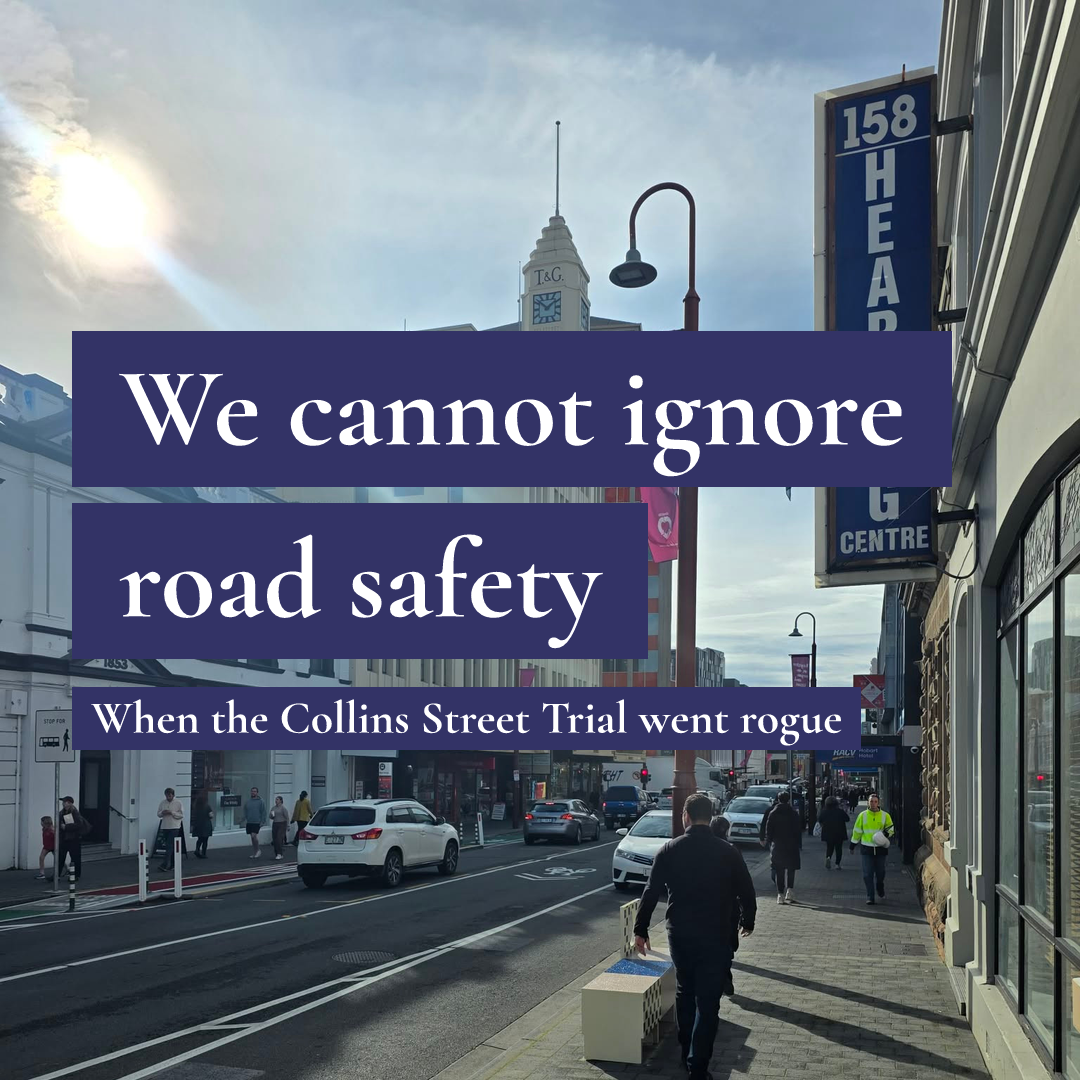
The Collins Street bike-lane trial was promoted as a project that would make cycling safer. Yet little more than a year after installation began, we are now aware of four reported accidents associated with the changed street environment, including a cyclist suffering a broken arm after striking one of the concrete lane separators.
That injury reportedly occurred approximately a week before the trial was officially launched on 30 May 2025. In other words, a serious warning arrived before the ribbon had metaphorically been cut. The appropriate response should have been an immediate safety assessment of the barriers—not an expectation that the community wait until the conclusion of a two-year trial.
This matters because Collins Street did not previously have a significant history of accidents involving cyclists.
An independent traffic assessment examined Department of State Growth crash data for the section of Collins Street between Molle and Murray streets from January 2019 to September 2024. While 59 general traffic crashes were recorded over that period, only one involved a cyclist—and that incident resulted in property damage only after a passenger opened a car door into the rider’s path.
The assessment concluded that there was “no notable history of bicycle crashes” along the corridor before the new infrastructure was installed.
That distinction is important. Nobody should claim Collins Street was entirely accident-free. It was not. But the available data showed that hundreds of cyclists were already traveling along the street each weekday without any established pattern of cyclist injury crashes. The City itself says between 350 and 450 bicycle trips were being made along Collins Street each weekday before the trial.
We must therefore ask a simple question: has infrastructure introduced in the name of cyclist safety created new hazards for cyclists?
It beggars belief that some elected members who were fierce advocates of this trial continuing no matter what now publicly declare concerns. The information was not new or hidden. The first accident was a week prior to the start of the trial!!
Those are serious allegations and serious safety concerns. But they are also difficult to reconcile with what residents and some elected members have repeatedly been told.
Whenever we raised concerns about accidents, visibility, accessibility or the design of the Collins Street trial, the familiar answer was that we should wait until the trial had run its course - a strategy championed by pro-cycling elected members.
But a trial is not a two-year immunity from scrutiny.
The entire purpose of a trial is to observe what happens, learn from emerging evidence and make changes before further harm occurs. When an accident exposes a possible design fault, the clock should not keep ticking while everyone waits politely for the final report.
We would never accept that approach in a workplace. We would not leave a known trip hazard in place for two years merely because the floor was being “trialed”. Road infrastructure carrying cyclists, pedestrians, motorists, buses and people with disability deserves at least the same common sense.
This should not become another argument between people who support cycling and people who do not. I support safe transport choices. Cyclists deserve infrastructure that protects them rather than placing rigid, poorly visible obstacles directly beside their path.
Council should now commission an immediate and genuinely independent safety audit of the Collins Street barriers and other trial infrastructure. The findings should be made public, along with an accurate register of reported accidents, injuries and near misses. Any barrier found to be unsafe should be replaced or removed without waiting until 2027.
We should also examine why warnings from members of the public, affected businesses, accessibility advocates, cyclists and elected members were apparently not acted upon sooner.
I have emails where I reported to council myself accidents with the elderly in Collins street.
There is no shame in changing a trial when evidence shows that part of it is not working. The shame would be knowing that people have already been injured and continuing to defend delay.
Public safety is not an inconvenience to be managed until the trial ends. It is the first test the trial must pass.